For most businesses, moving money is still slow, expensive and stuck in banking hours. An international supplier payment can take days to arrive, pass through several banks that each take a cut, and leave everyone unsure where it is until it lands.
Stablecoins offer a different way to move value. They're digital dollars that travel over blockchain networks: they hold a steady value, settle in minutes and work around the clock. They've moved well beyond crypto trading, and businesses are now using them for payments, payouts and treasury.
Here's why they're worth a serious look, where they fit, and what to consider before you start.
What a stablecoin is, in plain terms
A stablecoin is a digital token designed to hold a stable value, usually one US dollar. The best-known stablecoins are backed by reserves such as cash and short-term government debt, and the issuer redeems tokens for dollars on request.
What makes them useful for business is the combination: the stability of the dollar with the speed and reach of the internet. You get money that behaves like a dollar but moves like an email.
Six reasons stablecoins are good for business
1. Faster settlement
Bank transfers, especially across borders, can take one to several business days. Stablecoin payments typically settle in minutes, and the recipient can see the funds as soon as they arrive. Faster settlement means suppliers get paid sooner, customer payments clear sooner, and less cash is tied up in transit.
2. Available 24/7, 365 days a year
Blockchain networks don't close for weekends, public holidays or cut-off times. A payment sent on Friday evening arrives on Friday evening. For businesses working across time zones, that removes a lot of waiting and chasing.
3. Lower cost for cross-border payments
International payments often pass through several intermediary banks, each adding fees and foreign exchange margins. Stablecoin transfers move directly between wallets, so the cost of sending money abroad can be much lower, especially for frequent or smaller payments where traditional fees hurt most.
4. Global reach from a single integration
Anyone with a compatible wallet can receive a stablecoin payment, wherever they are. That makes it easier to pay international contractors, reach suppliers in markets with limited banking access, and accept payments from customers abroad, without opening bank accounts in every country.
5. Access to dollars for international businesses
For companies outside the US, holding dollars through a traditional bank can be difficult or expensive. Stablecoins give businesses and their customers a practical way to hold and move dollar value, which helps manage currency risk in markets with volatile local currencies.
6. Transparency and programmability
Every stablecoin transaction is recorded on a public ledger, giving a clear, verifiable trail of when payments were sent and received. Stablecoins can also be built into software directly, which opens the door to automated payouts, instant marketplace settlements and payments that happen as soon as conditions are met.
Where businesses are using stablecoins today
- Paying international suppliers and contractors faster and at lower cost than wire transfers
- Marketplace and platform payouts to sellers, creators or drivers around the world
- Accepting payments from international customers without card or banking friction
- Treasury management, holding and moving dollar balances across entities and markets
- Consumer apps and wallets that let customers save, send and spend in digital dollars
What to think about before you start
Stablecoins are a strong tool, but they need the same care as any financial product. The main questions to answer are:
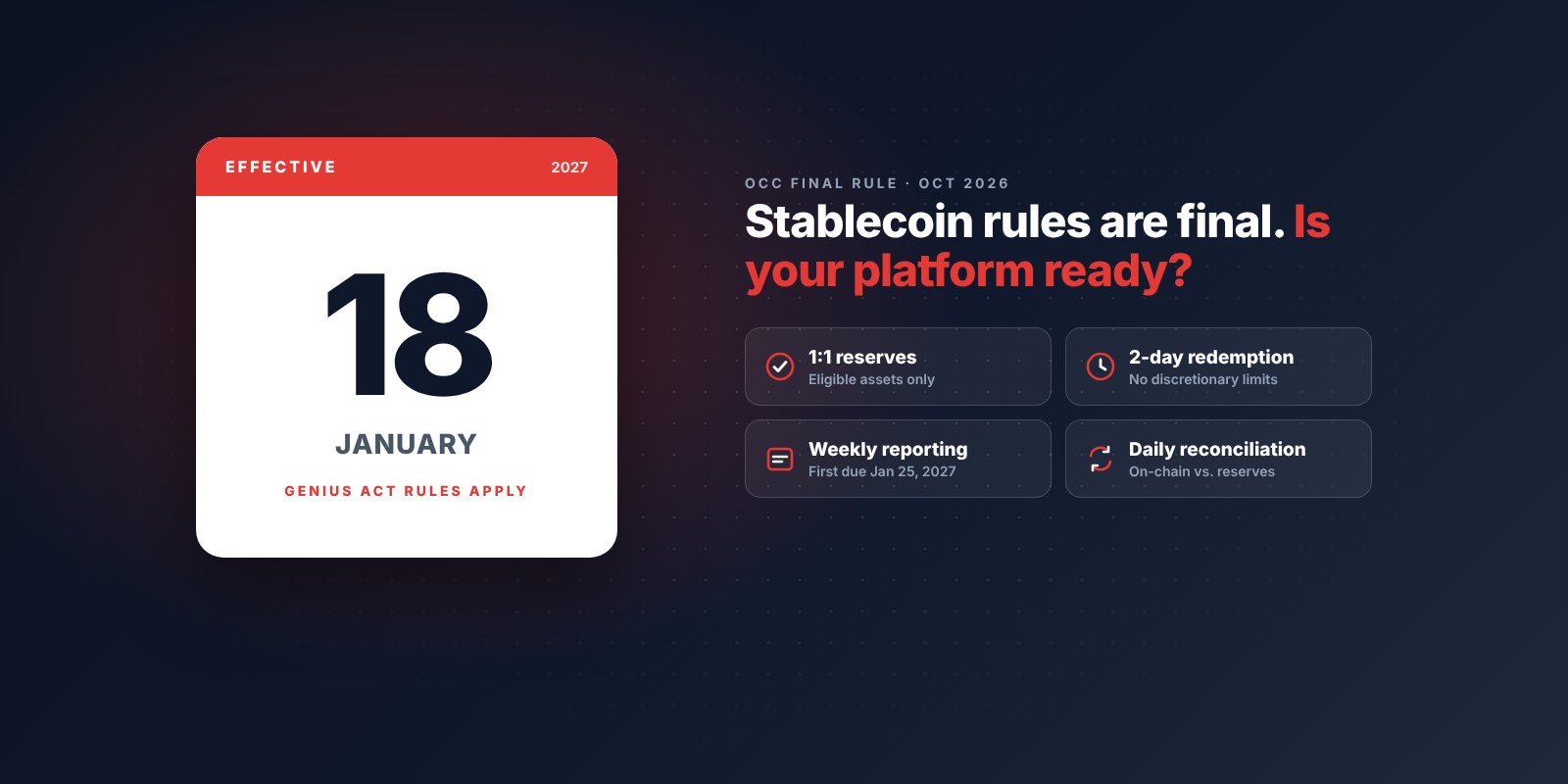
- Regulation and licensing. Rules depend on your market and what you're offering. In the US, the GENIUS Act has created a federal framework for payment stablecoins. We cover what it means for platforms in our article on the GENIUS Act.
- Which stablecoins to support. Not all stablecoins are equal. Look at who issues them, how they're backed, and how widely they're accepted.
- Custody and security. Decide whether you'll hold funds yourself or through a regulated custody partner. For most businesses, a proven custody provider is the safer route.
- Getting in and out of local currency. Your customers and suppliers will still need to move between stablecoins and their bank accounts, so on- and off-ramp partners matter.
- Accounting and tax. Talk to your accountant early about how stablecoin holdings and payments are recorded and taxed where you operate.
Build, integrate or partner?
There are three common routes for adding stablecoins to a business:
- Use an existing provider to send and receive stablecoin payments, with little or no development. This is fastest, but you'll have less control.
- Integrate stablecoin payments into your own platform through APIs from custody, payment and on- and off-ramp providers.
- Build a full product, such as a branded wallet or payments app, when stablecoins are central to what you offer your customers.
We took the third route with Duzo Money, a stablecoin payments app now live on the App Store and Google Play. You can read how we built it in our Duzo Money case study.
The bottom line
Stablecoins give businesses faster, cheaper and always-on payments with global reach, while keeping the stability of the dollar. With clearer regulation arriving and the infrastructure maturing, now is a good time to work out where they could save you time and money.
If you're weighing up whether stablecoins make sense for your business, we're happy to talk through the options, from a simple integration to a full product.
Frequently asked questions
What is a stablecoin?
A stablecoin is a digital token designed to hold a stable value, usually one US dollar, typically backed by reserves such as cash and short-term government debt. It combines the stability of the dollar with fast, round-the-clock transfers over blockchain networks.
Why would a business use stablecoins?
Stablecoin payments settle in minutes, work 24/7, can cost much less for cross-border transfers, and reach anyone with a compatible wallet. Businesses use them for supplier and contractor payments, marketplace payouts, accepting international payments and treasury.
Are stablecoins regulated?
Regulation depends on the market. In the US, the GENIUS Act created a federal framework for payment stablecoins. Businesses should check licensing requirements where they operate and work with regulated custody and payment partners.
Do we need to build our own stablecoin app?
Not necessarily. Many businesses start with an existing provider or integrate stablecoin payments through APIs. Building a full product makes sense when stablecoins are central to what you offer customers.