
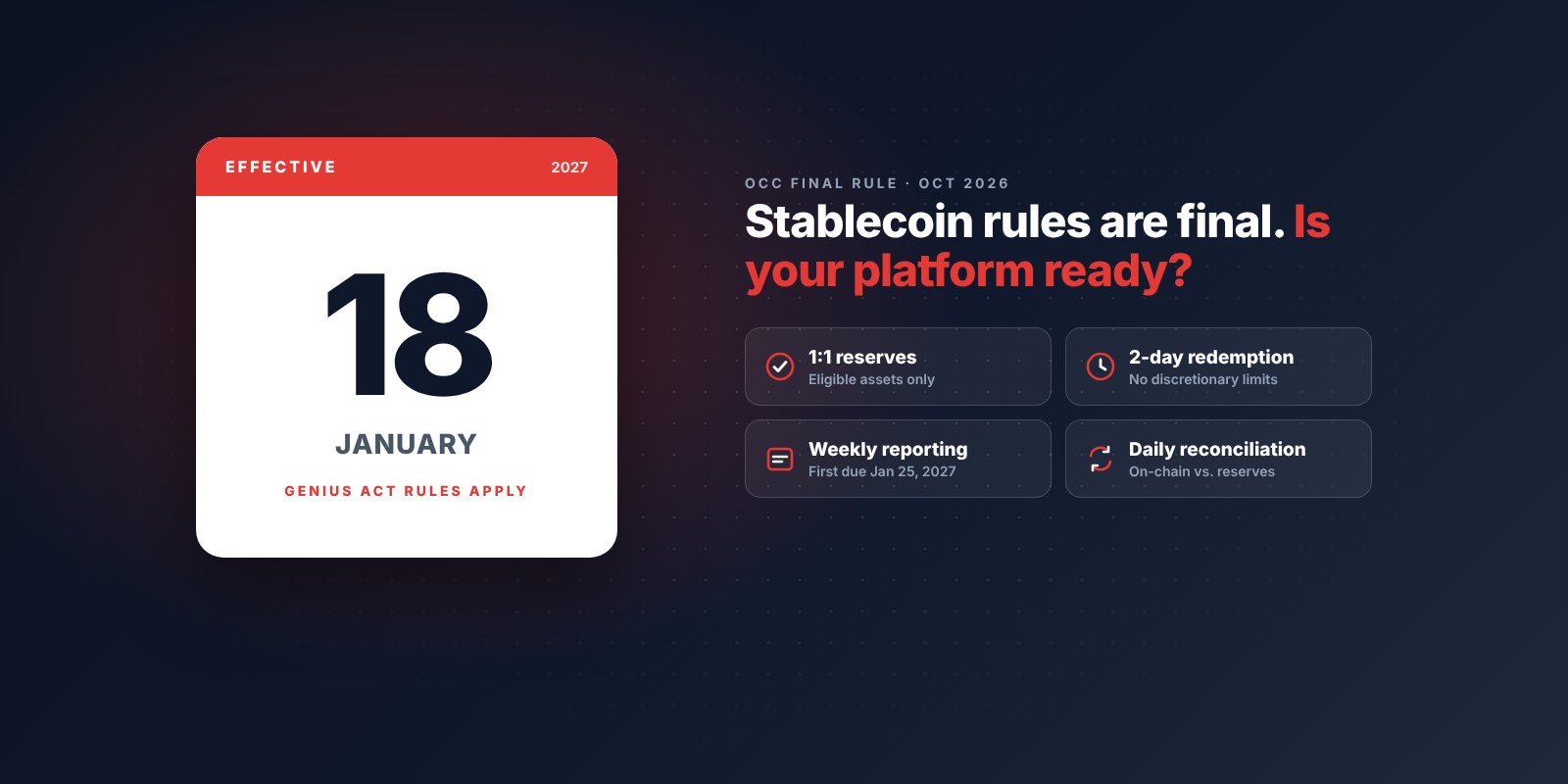
On October 21, 2026, the Office of the Comptroller of the Currency (OCC) finalized its rules implementing the GENIUS Act, the US federal framework for payment stablecoins. It's the first final GENIUS Act rule from a federal banking regulator, and both the rule and the Act take effect on January 18, 2027.
Most of the coverage has focused on what this means for issuers and banks. For product and engineering teams, the more practical question is what it means for the systems you build. A lot of the rule turns into software requirements, and less than three months is not a long runway.
What the final rule requires
The OCC's rule creates a new part of its regulations (12 CFR part 15) covering reserves, redemption, capital, custody, reporting and supervision for the issuers under its jurisdiction. Based on the rule and early legal analysis, the headline requirements are:
| Area | What the rule requires |
|---|---|
| Reserves | 1:1 backing with eligible assets only, such as cash, insured deposits, Treasuries with 93 days or less to maturity, overnight Treasury-backed repos and government money market funds |
| Concentration | No more than 40% of reserves with any single counterparty, with some carve-outs |
| Liquidity | At least 5% of reserves held daily in demand deposits or a Federal Reserve account, down from 10% in the proposal |
| Redemption | Within two business days, under a published redemption policy, with no discretionary limits |
| Large outflows | Notify the OCC within 24 hours if redemption requests exceed 10% of a stablecoin brand's outstanding value in a day |
| Disclosure | Monthly reserve composition published on the issuer's website |
| Reporting | A confidential weekly report to the OCC, first due January 25, 2027, plus quarterly financial reports |
| Capital | A $5 million minimum, plus an operational backstop equal to 12 months of expenses |
| Yield | Still no interest or yield paid solely for holding, using or retaining the stablecoin, now judged case by case |
Two areas are still open. Anti-money laundering, Bank Secrecy Act and sanctions requirements are being handled in a separate rulemaking with the Treasury, and other agencies, including the FDIC and the Federal Reserve, are still working on their own rules.
What this means for the systems you build
Whether you're an issuer, a bank partner, or a fintech building a wallet or payments product on top of a regulated stablecoin, several of these requirements land directly in your architecture.
Reconciliation has to be daily, not monthly
Weekly regulatory reports and monthly public disclosures only work if on-chain token supply and off-chain reserves are reconciled continuously. As Sheppard Mullin's analysis points out, a monthly attestation cycle won't be enough on its own.
In practice that means a single internal ledger that records every mint, burn, transfer and reserve movement, and automated jobs that compare it against the chain and the custodian every day. Breaks should raise an alert, not wait for month-end.
Redemption is now a service level
A two-business-day redemption window with no discretionary limits is effectively an SLA. Your redemption flow needs clear states (requested, approved, funds sent, completed), timestamps on every step, and monitoring that tells you before you're at risk of missing the window.
The 10% outflow trigger adds a real-time requirement: you need to know, within the day, how much of a stablecoin brand's outstanding value is being redeemed. That's a metric to build into your dashboards now, not something to calculate after the fact.
Reporting should come from the system, not from spreadsheets
A weekly report due from late January means the data has to be reliable and repeatable. Teams that build reporting directly from their ledger, rather than exporting and adjusting by hand, will find this far less painful, and far easier to defend in an examination.
Rewards programs need a second look
The yield ban hasn't changed, but the OCC dropped the proposed presumptions about which rewards break it. Instead, as CoinDesk reports, it will look at the facts of each arrangement, and it won't assume that programs which predate the Act comply. If your product pays any form of reward linked to stablecoin balances, now is the time to review how it's structured with your legal team.
Design for the rules that aren't final yet
AML and sanctions requirements are still in proposed form. The practical approach is to build compliance logic so it can change without a rebuild: rules and thresholds in configuration, a clear audit trail of every check, and onboarding flows that can ask for more information without breaking the customer journey.
Elsewhere in stablecoins this week
The US isn't the only place moving quickly. In the same week:
- HSBC launched a Hong Kong dollar stablecoin for users of its PayMe app, after becoming one of the first issuers licensed under Hong Kong's stablecoin regime.
- SoFi launched a tokenized deposit issued by its national bank, convertible one-for-one into its SoFiUSD stablecoin.
- Malaysia and Thailand's central banks joined Singapore's BLOOM project, which is testing cross-border payments using stablecoins and tokenized money.
The direction is clear. Stablecoins are becoming regulated financial infrastructure, and banks are now building on them alongside crypto-native firms.
A short checklist before January 18
- Map every money movement in your product to a ledger entry, on-chain and off-chain.
- Automate daily reconciliation between the ledger, the chain and your custodian or reserve accounts.
- Instrument your redemption flow with states, timestamps and alerts against the two-day window.
- Track redemption volume per stablecoin brand in real time.
- Build regulatory reports from your ledger, not from exports.
- Review any rewards tied to balances with counsel.
- Keep compliance rules configurable while the AML and sanctions rules are finalized.
This article is a summary for product and engineering teams, not legal advice. Check the final rule and talk to your counsel about how it applies to you.
DevkoLabs designs and builds stablecoin, payments and fintech platforms, from ledgers and reconciliation to wallets, custody integration and the apps customers use. If you're preparing for January, we're happy to help you work out what your systems need.
Frequently asked questions
When do the GENIUS Act stablecoin rules take effect?
The OCC's final rule and the GENIUS Act itself take effect on January 18, 2027. The OCC's first weekly stablecoin report from issuers under its supervision is due January 25, 2027.
How quickly must payment stablecoins be redeemed under the OCC rule?
Issuers must redeem within two business days under a published redemption policy, and cannot apply discretionary limits. They must also notify the OCC within 24 hours if redemption requests exceed 10% of a stablecoin brand's outstanding value in a day.
Can stablecoin platforms still offer rewards on balances?
The GENIUS Act still prohibits interest or yield paid solely for holding, using or retaining a payment stablecoin. The OCC will judge rewards arrangements case by case and will not assume that programs which predate the Act comply, so any balance-linked reward should be reviewed with legal counsel.